
- September 12, 2026
- 4 min read
Share This ARTICLE
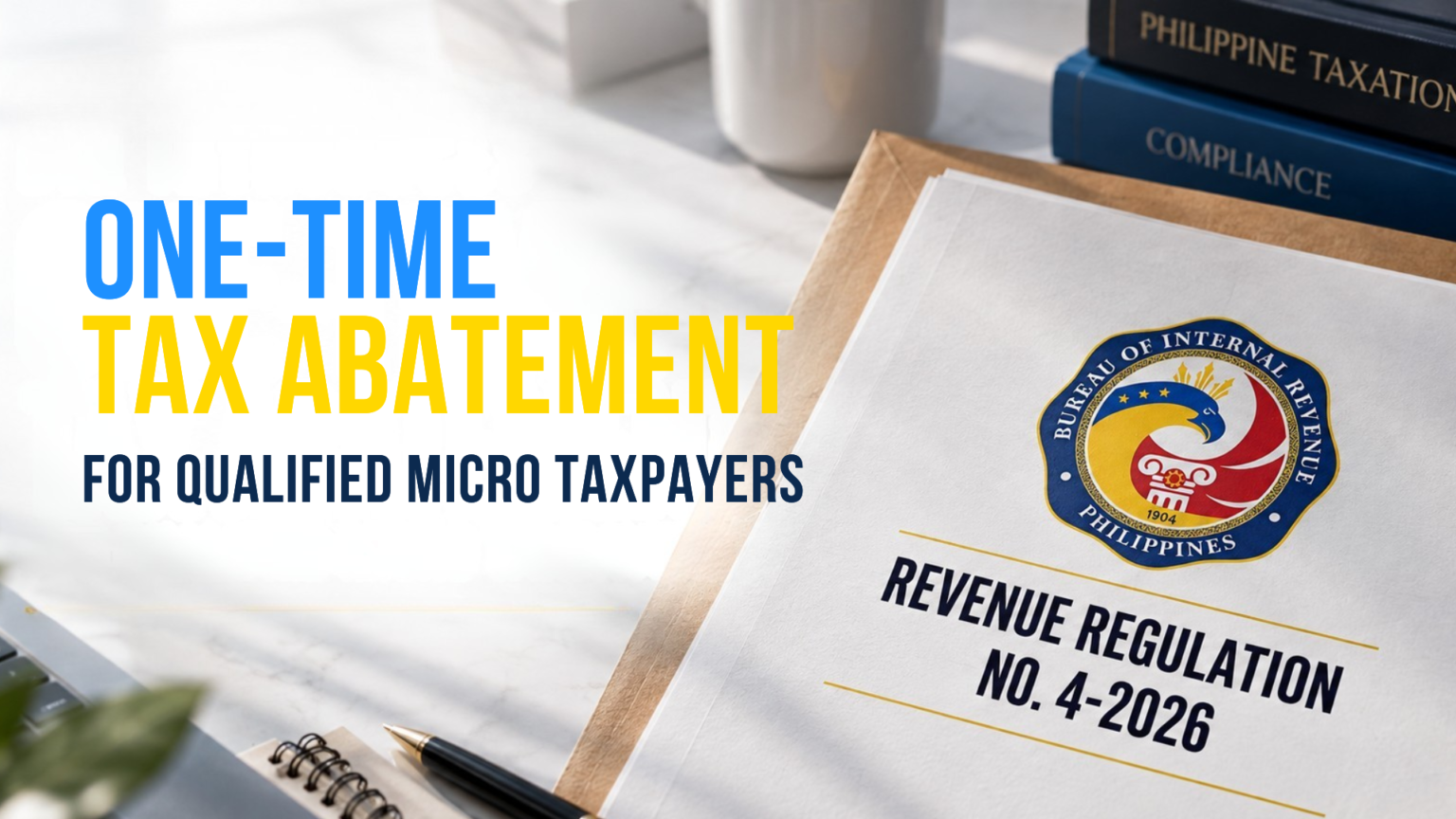
For small businesses, unpaid tax liabilities can become more difficult to resolve as penalties and other charges accumulate. To provide qualified micro taxpayers with a simpler way to address certain outstanding obligations, the Bureau of Internal Revenue (BIR) issued Revenue Regulation No. 4-2026, introducing a one-time tax abatement program.
Under the program, eligible micro taxpayers may settle certain covered tax liabilities through a fixed ₱5,000 abatement fee, subject to the requirements and conditions set by the BIR.
Who May Qualify?
The program is intended for micro taxpayers with gross sales of less than ₱3 million.
To qualify, the covered basic tax and/or penalties must generally not exceed ₱80,000, and the account or case must have existed as of December 31, 2025.
The regulation covers several types of outstanding tax matters, including:
• Delinquent tax accounts
• Administrative protests that are still pending with the BIR
• Tax collection cases filed in court
• Tax cases under dispute before the Department of Justice or the courts, including cases that are not yet final and executory
• Pending compromise settlement requests
• Pending requests for abatement or cancellation under Revenue Regulation No. 13-2001
• Certain criminal tax violations that have not yet been filed in court, subject to approval by the Commissioner or authorized representative
• Accounts payable or amounts due to the BIR recorded in the taxpayer's books
• Cases where there is no basic tax due but penalties remain outstanding
How Does the Abatement Work?
Qualified taxpayers must manually file the One-Time Abatement for Micro Taxpayers Application Form with the Revenue District Office (RDO) that has jurisdiction over the taxpayer.
The application must be filed separately for each taxable year covered by the request.
Once the BIR accepts the application, the taxpayer must pay the ₱5,000 abatement fee using BIR Form No. 0605, either electronically or manually, within five working days from acceptance.
Proof of payment must then be submitted to the concerned RDO within another five working days from payment.
Failing to submit the required proof within the prescribed period will cause the application to be void, although the taxpayer may still refile.
What If the Application Is Denied?
The ₱5,000 fee is non-refundable even if the application is withdrawn or denied. However, the amount may be treated as a partial payment toward the taxpayer's outstanding obligation.
Mark the Deadline
The one-time abatement program is available until December 31, 2026, unless the BIR extends the period.
The regulation takes effect on July 7, 2026, or 15 days after publication in the Official Gazette or on the BIR website, whichever comes first.
Why This Matters for Micro Businesses
For qualified taxpayers, the program may provide an opportunity to address certain long-standing tax concerns through a more straightforward settlement process.
However, eligibility is not automatic. Taxpayers should review their records, determine whether their outstanding obligations fall within the coverage of the regulation, and ensure that all filing and payment requirements are properly completed.
If you are unsure whether your business or tax case qualifies, professional assistance can help you assess the applicable requirements and determine the appropriate next steps before proceeding.
Source:
ALSO READ
Putting our clients' interests at the center of everything we do.
Follow us:
Contact Us
Office Hours
- Mon-Fri: 9 AM to 6 PM
- Sat-Sun: Closed
© 2026 R.M. Veluz & Co., CPAs. All Rights Reserved.